

Share


A mustard seed is remarkably small. Yet from it can grow something disproportionately large.
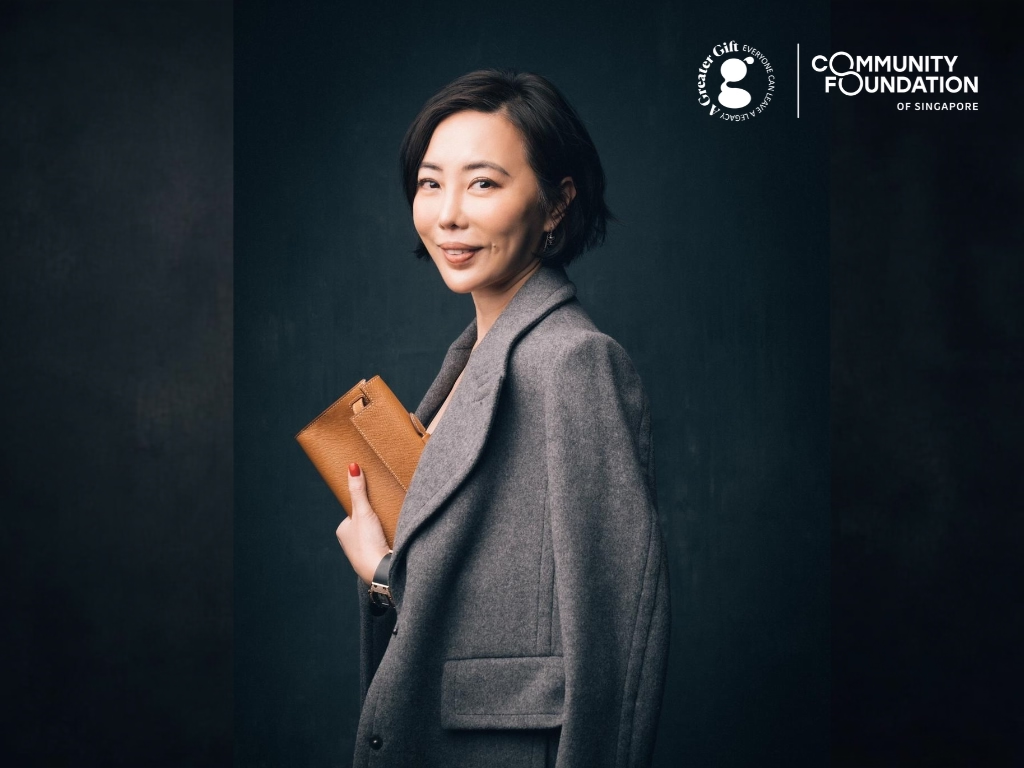
When Lynn Hermijanto’s father passed away in 2016, preparing his eulogy confronted her with a question she had not expected.
“Death has an uncanny way of making us introspective,” she says. “Standing there, thinking about how his life would be remembered, I found myself asking a rather uncomfortable question: when I am gone, what will my story tell?”
That question reshaped the way she thought about wealth, purpose and legacy.
After more than two decades in banking and investing, much of Lynn’s professional life had revolved around capital — how to grow it, preserve it and deploy it well. Increasingly, however, she found herself asking a different question:
What is capital ultimately for?
Her search for an answer led her to establish Mustard Seed Foundation, supporting women and young people whose circumstances have constrained their choices and opportunities.
Yet for Lynn, legacy has never been simply about what we leave behind financially.
“Inheritance is what you leave to someone. Legacy is what you leave in someone,” she says.
“Legacy is not the achievements we list or the assets we accumulate. It is the residue of our character and contribution — the lives we touch, the possibilities we unlock and what continues to bear fruit long after we have left the room.”
Building a legacy while you are still here
That conviction has shaped not only what Lynn gives to, but how she gives.
Through Mustard Seed Foundation, she wanted to move beyond episodic generosity towards something more intentional and enduring. She came to believe that effective philanthropy requires more than generosity: it requires clarity of purpose, trusted partners, good governance and the humility to keep learning.
A donor-advised fund with the Community Foundation of Singapore (CFS) provided that structure.
“It allows me to be thoughtful and strategic about where capital goes, while CFS provides the governance, administration and due diligence behind it,” she says.
“For someone from banking, perhaps unsurprisingly, I value that combination: conviction with discipline; heart with structure.”
It also gives Lynn greater freedom to focus on what she believes matters most: understanding problems deeply, building relationships and staying close to the communities she hopes to serve.
One of her greatest lessons has been simple:
Proximity changes everything.
“Capital matters enormously. But capital without proximity can be a blunt instrument. I have come to believe that the true power of capital lies not simply in what it provides, but in the agency it creates — the choices it restores, the possibilities it unlocks and the capacity it gives people to shape their own futures.”
“And sometimes the most valuable thing we can bring isn’t another cheque. It is attention, relationships, access, community and the willingness to journey alongside someone for the long haul.”
That philosophy is reflected in Kita Bisa Collective, an initiative Lynn has been spearheading alongside family offices, social agencies and corporates. Through financial literacy, co-savings, mentoring and community, it seeks to help young people build confidence, agency and a greater stake in their own future.
Even its name captures the philosophy. Kita Bisa means “we can.”
“Not ‘I can help you.’ Not ‘we will rescue you.’ We can.”
“For me, there is a fundamental difference between doing something for a community and building something with one. The latter recognises the dignity, agency and capacity that already exist within people.”
Planning for what continues beyond us
For Lynn, legacy giving is not something to postpone until the end of life.
“I would much rather build and test that legacy while I am alive — giving now, learning now, making mistakes now and discovering what actually creates meaningful change.”
She has also incorporated philanthropy into her longer-term estate planning so that the causes she cares about can continue beyond her lifetime.
That makes stewardship and institutional continuity especially important.
“The question is not simply whether my capital will continue to be distributed. It is: who can faithfully steward not just my capital, but the purpose attached to it when I am no longer in the room?”
Perhaps that is ultimately what legacy asks of us: not simply what we will leave behind, but what we will set in motion.
For Lynn, the answer returns to the mustard seed.
Something small, faithfully planted, can become something far larger than the person who planted it.
“Don’t underestimate the seed in your hand simply because it looks small. Plant it.”
Because legacy does not begin with how much we have. It begins with what we choose to do with what is already in our hands.